内容概览与问题思考
在完成前两章的阅读之后,离吃饭还有点时间,我决定开始撰写本次的笔记更新。首先我基本确定,这份笔记应该是没有人会看的,在光电子领域,不同方向采用的技术可能是云泥之别,这就意味着单个方向专业知识的受众数量是稀少的。然而,把知识分享出来,相比于记录在本地,能够带来更多的满足感和成就感,对自己是一种激励和奖赏。假使真有人看到这里,就更好了。
A brief introduction
First, let’s talk about the learning contents, the book we are going to deal with is called: Silicon Photonics: An Introduction, written by Graham T. Reed and Andrew P. Knights, both are professionals and expert in this field. This book is friendly for readers like me student about to graduate and continue to chase for a master degree in this field. Main titles of each chapter are listed as follow:
- Fundamentals
- The Basics of Guided Waves
- Characteristics of Optical Fibres for Communications
- Silicon-on-Insulator (SOI) Photonics
- Fabrication of Silicon Waveguide Devices
- A Selection of Photonic Devices
- Polarisation-dependent Losses: Issues for Consideration
- Prospects for Silicon Light-emitting Devices
So far, I’ve finished reading the first two chapters, they are mostly basic theories about wave guide and has been introduced in my undergraduate course Integrated Photonics and Electromagnetic Field and Wave. For me, the front part of this book is not hard to understand, just like having a review. However, I still obtain many theoretical details that been ignored or misunderstood in my pervious study.
Key Questions
The part titled as Siliconizing Photonics is given by Dr. Mario Paniccia of Intel Corporation, who gives some valuable ideas on today’s (10 years before in fact, but still works today) Optical Communication and future develop orientation. It says “Moore’s law has resulted in significant performance gains while simultaneously bringing about significant cost reductions ” and raises several questions:
Can we ‘siliconize’ photonics?
Can we call on the decades of research and manufacturing experience gained from the microelectronics industry and apply it to photonics?
Could silicon be used as an alternative to more exotic materials (such as InP or LiNbO3) typically used to produce optical devices?
Could one monolithically integrate multiple photonic circuits on a single silicon chip to increase performance while simultaneously reducing cost?
Could one implement standardization and high-volume manufacturing techniques to reduce cost?
Could we combine electronics with photonics to bring new levels of integration, and possibly a derivative form of Moore’s law to photonics?
Thinking
十年之后的今天,这些问题中的某些已经有了很明确的答案,七月初在北大的研讨会,我看到了Acacia展示的这张图片,很好的体现了当前光电集成的新水平:
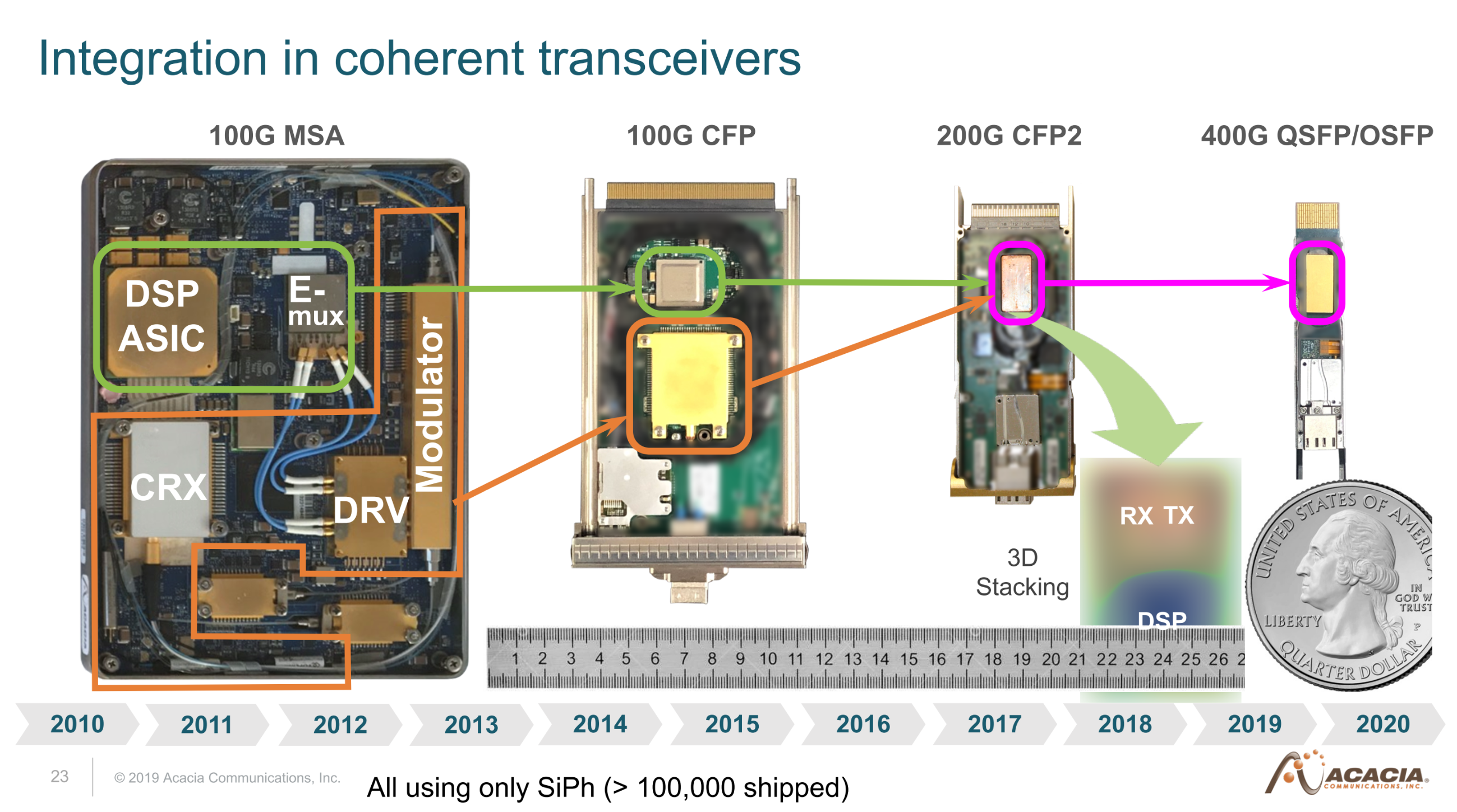
周治平老师一直强调,Silicon Photonics翻译成硅基光子学是错误的,而应当是硅基光电子学,因为这里的Silicon一词意指传统的微电子产业,而Silicon Photonics绝对不仅仅是光子集成,而更要处理好光子和电子之间的关系。问题一正是大家努力的方向,这里的siliconize我觉得可以理解成在传统微电子芯片上引入光子,能解决很多目前无法逾越的瓶颈。
对于第二个问题,周治平老师也提出了自己的理解,传统微电子芯片中是不包含电流源的,因此在光电子芯片中光源也未必需要集成在芯片内,这一点对于提高芯片集成度有很大的意义。
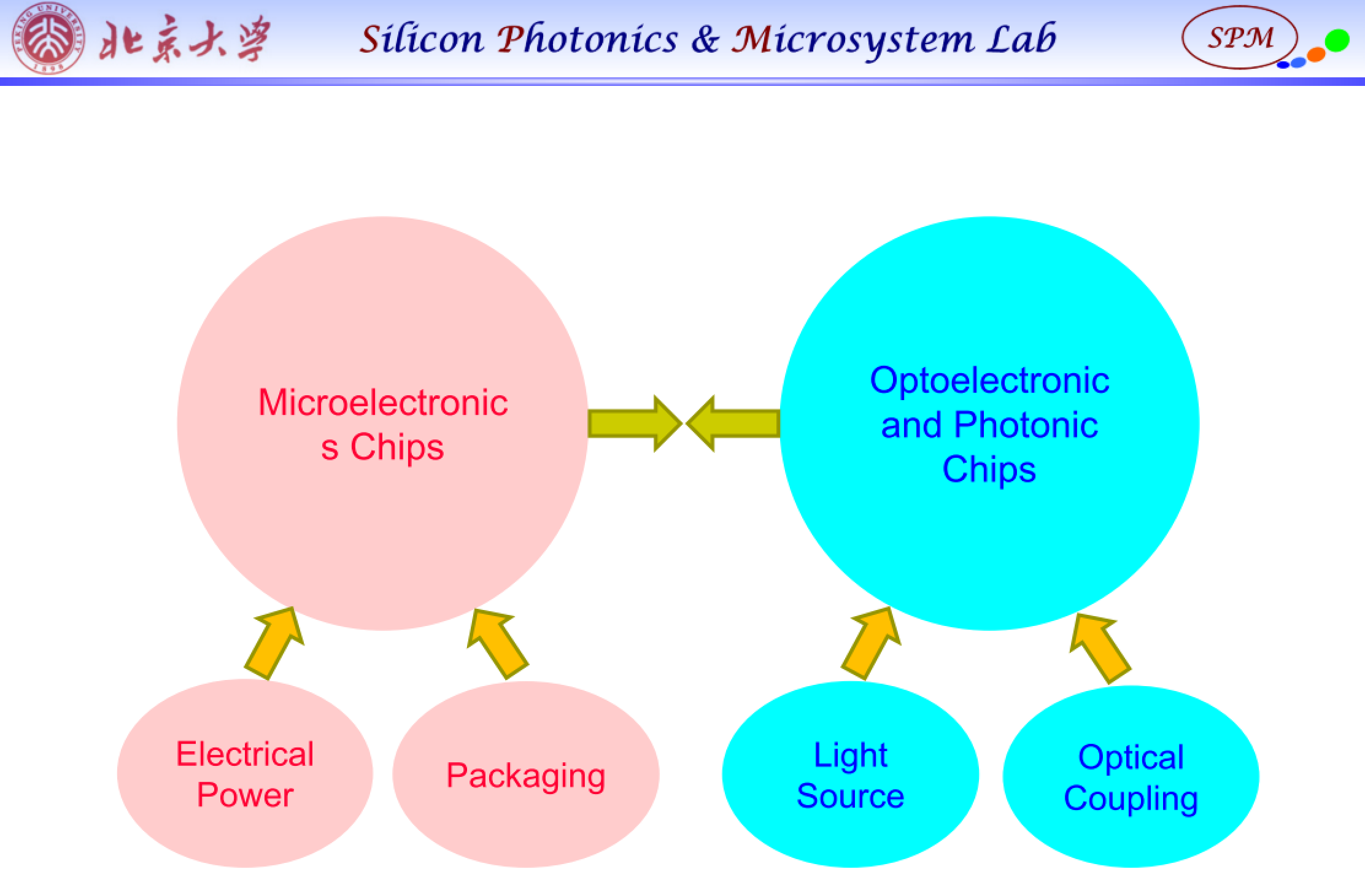
第三个问题,Si作为一种材料能否替代InP和LiNbO3来制造光器件呢?从目前来看,还是不可以的。Si材料本身的缺陷限制了其在有源器件上的应用:
- 硅是间接带隙半导体
- 硅晶体具有中心对称结构,无Pockels效应
为了解决这些问题,人们采用了一系列办法,但仍然无法脱离这些功能性材料的应用,而主要是采用III-V/硅基混合集成的方式,研究的主要是集成的方式和手段。比如硅基激光器,有Laser Box、倒装焊、芯片键合、异质生长等集成方式,各自的工艺和实现效果也大不相同。 在调制器上,可以通过等离子色散效应来实现折射率调节,此外利用铌酸锂薄膜键合在硅基上也是一种前沿的解决方法:
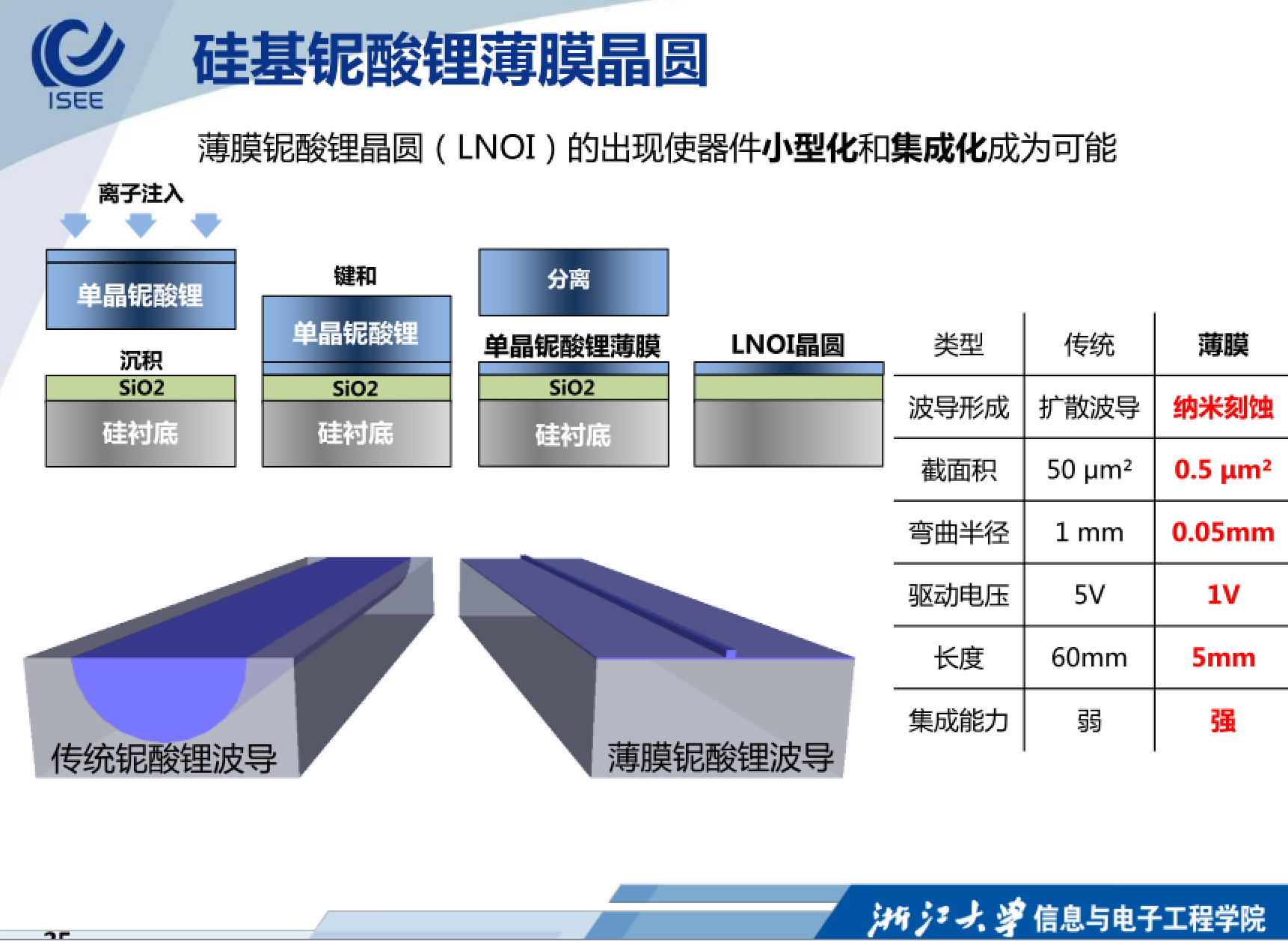
总的来说,硅材料还远远没有达到能取代III-V材料的地步,现阶段硅基有源器件更多的是往混合集成的方向前进。对于最后一个问题,其实硅基光电子学某种程度上就是微电子在摩尔定律上的延续,Nature提出了More than Moore的概念,未来必然产业的发展应当是从需求出发引发技术的更迭。

从各种意义上来说,光子作为一种信息载体,未来必然会肩负越来越多的使命。从3G的出现到5G技术的整装待发,智能手机占领人类的生活只是这几年的事情,可预见的是,技术带来的革命远未终止,只会越来越快。在这场飞速向前的旅程中,已经迎来了光子的黎明,似要带领人类进入新的纪年。
无论对于产业界还是对于个人,这都是机遇也是挑战,一起加油吧!
2019.7.23 @ZY
 Edit this page